Mending Modernity’s Split from Reality Through Corrective Thought and Action
Authored by Ben G. Price, CELDF Education Director, Kai Hushke, CELDF Executive Director, and Terry Lodge, Esq., CELDF Legal Counsel
INTRODUCTION
A bold, transformative change in how modern society describes the world to itself and future generations is necessary if this society is to change its trajectory and avoid the worst of the ecological catastrophes already unfolding on a global scale. To succeed, the narrative must organically emerge at an acute angle from the course laid out by current power arrangements. It should be simple to understand. And it must correct cultural bad judgment, mistaken social premises, and distorted relationships between people and nature (using the prevailing othering word), and between the governed and those who govern.
We suggest that the natural catastrophes arising because of human-corporate behavior can be traced back to cultural belief in concepts arising from the dogmatic bifurcation of reality into humans and “nature.” Assumptions like the primacy of individuality, the exclusivity of rights attached to property, the associated abdication of reciprocal collective responsibility to community, as well as the imprudent application of mechanical reductionism in assessing the nature of living systems, can be traced back to a belief system out of step with reality.
The right to be whole and to heal the wounds caused by amputating communities of people from their land base would seem intuitive, a cause without controversy. But the history of land enclosures, privatization of resources, monopolization of trade, and private influence over commercial legislation in the United States have culminated today in an absurd relationship between human communities and their governments in which a matrix of commercially biased laws and bureaucracies make it illegal for people to protect their local ecosystems.
Most industrial assaults against the natural environment occur in particular places that encompass a human community. Since every state government, to varying degrees, preempts (i.e., forbids) local governments from regulating ecologically destructive industrial activities more strictly than state law establishes (i.e., ceiling preemption), when corporate lobbyists succeed (and they generally do) in limiting or eviscerating environmental protections by influencing legislation, protection of the local environment in every American community is made impossible to achieve.
What we propose is a change to this arrangement that will be on its face a democratizing corrective to institutionalized injustice. But at a deeper level, what we propose is intended to do much more. It is designed to begin the process of reuniting human and other-than-human communities (referred to with the othering word “ecosystems”) within politically distinct biological communities that we herein refer to as natural communities.
To quickly address any challenge, belief, or question of whether humans are indeed separate from nature, as post-enlightenment Western cultural theory suggests, we offer this simple mnemonic. It is the prosaic Law of Threes often recited by outdoor enthusiasts, and it asserts that a human can continue to live approximately
Three minutes without air
Three days without water
Three weeks without food
From this we see that actual separation from the natural environment results in death for humans. Sustainable separation is a cultural delusion. Reality is not actually bifurcated, despite the long-standing and arguably pathological split accepted as received knowledge by modern society. As for human supremacy over nature, if the ability to irredeemably destroy a significant portion of the other-than-human world equates to supremacy, we are supreme. But it has begun to dawn on a broad segment of the public that our cultural battle for ascendency over the natural world is going to be an embarrassingly short-lived rise to the top.
We anticipate that critics of our proposal will be many in a world grown hidebound and indulgent toward asymmetrical power arrangements. But we can find common cause among the 90,837 municipal jurisdictions in the U.S. by answering those critics with common sense. Despite a legal system that incentivizes perpetuation of society’s lucrative rupture with reality that has us believing in limitless growth on a finite planet, there is cause for hope. At least one alternative, the one we propose, can be implemented without a total revamp of all formal political arrangements.
To regenerate biomes, and to reverse the energy-intensive trajectory of globalism and the planetary upscaling of environmentally destructive human economic processes, the stage must be set for localizing environmental decision-making. Implementing biocentric governance that’s built on the premise that biological integrity is a natural right is required. And, specific political changes in the United States, chief among them the devolution of state authority over land use, community rights, and environmental protection to local people and governments, is indispensable.
The municipal model itself, rooted in imperial Roman law for governance of conquered territories, must be scrapped. In its place, peoples’ assemblies run by established local residents through a form of communitarian democracy recommends itself. A devolution of federal and state authority over the land use and environmental decisions of Indigenous and non-Indigenous populations is needed simultaneously.
We argue that these proposed reversals of exclusive government control over the biological integrity of natural communities are legitimate and necessary, even as they admittedly pose challenges to legal claims to land and resources as property. Our proposal recognizes personal property rights, but we insist that the use of private property that entails ecological harm has degenerated into a libertine privilege that’s rewarded with government permits that legalize the harm and immunize the permit holder from responsibility to the harmed community.
We recommend that land use and environmental law be brought into accord with empirical reality by recognizing the ineluctable fact that biological integrity is a natural and inalienable condition of natural communities, that the public trust lies in having the federal and state governments not abrogate official obligations to prevent harm to life-sustaining biological systems and that those governments have violated that trust.
This breach of trust is the proximate cause of a rift in the social contract said to bind citizens to lawful behavior in exchange for government’s obligations to protect the public. It thwarts official recognition of the natural right of biological integrity which acknowledges the rights of natural communities not to have their biological integrity diminished or destroyed. Worse, the institutional breach of trust makes it impossible for there to be plenary authority of people’s assemblies in each natural community with power to prohibit or limit, at their discretion, environmentally destructive practices.
Public Trust Doctrine
The Public Trust Doctrine posits that “the sovereign” will hold public lands and resources in trust on behalf of the public. While judges and lawyers evoke the Public Trust Doctrine as the public’s primary bulwark against commercial overexploitation of nature, it typically takes the form of bungled attempts to impose “public trust” from above by court or executive powers that allow overexploitation and ecological destruction to continue at full throttle. At the same time, public understanding of the Doctrine is overly romanticized by reliance on the naive belief that we are participants in an extant representative democracy.
Myles Douglas Young, Administrative Editor at The Georgetown Environmental Law Review, wrote in April 2021, in an article titled “The Public Trust Doctrine: A Cracked Foundation,”
“The Public Trust Doctrine has been a major player in environmental law and property law since the 1800s. The first major case to address the Public Trust Doctrine in the United States was Arnold v. Mundy, in which the New Jersey Supreme Court held that the public, rather than the King or the federal government, owns the nation’s navigable waters, which are held by the government in trust.”[1]
Young went on to argue that the Doctrine, with origins in ancient Rome, and with historic echoes found in the Magna Carta, has been misinterpreted and consistently narrowed by U.S. courts to protect commercial uses of waterways and other “natural resources.”
We take the position that land use and environmental law cannot legitimately have as their foundation only commercial interests, and we grieve with Young that the Doctrine “will likely remain in its current form for years to come.”
To average American citizens, the name “Public Trust Doctrine” suggests that benign outcomes are possible. Yet binding judicial interpretations of the Doctrine that are cemented into legal precedent as case law produce instead what can fairly be called predatory outcomes. The officially encouraged popular notion that government will faithfully protect “natural resources” entrusted to its care by the people raises hope that government will intervene on behalf of the public to halt environmental destruction. Those hopes have not been realized, based as they are on the rhetoric built up around the Doctrine and not on its diaphanous substance.
Nothing approaching a nature ethic can be found in the Public Trust Doctrine. There is no ethical foundation in it on which to build. Its cracked foundation allows the whole edifice to lean perilously in the direction of subsidizing private and commercial exploitation of natural communities with public funds, public lands, and public resources. The Public Trust Doctrine cannot be credited with much protection of the natural environment. Findings of its inapplicability, or constrained affirmations of its applicability, mainly sustain lucrative private overrides of it, no more.
Politicized commercial power encroaches on biological integrity, indirectly abrogating the most basic right implied by a social contract between those who govern formally or instrumentally as chartered agents of government, and the governed.
Biological Integrity: A Natural Right
Biological Integrity is generally defined as “the capability of supporting and maintaining a balanced, integrated, adaptive community of organisms having a species composition, diversity, and functional organization comparable to that of the natural habitat of the region.”
The realization and establishment of biological integrity as a natural right can have life-enhancing implications for ecosystems considered separately from the human community, but also for the collective interests of natural communities, in which humans and nature hold membership. Recognition of the right of biological integrity might also impinge on genetic engineering, involuntary medical procedures, animal cruelty, women’s reproductive rights, as well as for controlling biological predation by personified corporate property.
The test of human integrity as part of the biosphere of Earth will be the decisions we make about which laws and which rights will prevail going forward. Rights for synthetic, human-made corporate “entities” have been allowed to supplant the right to biological integrity around the globe and in every American hometown. This unnatural usurpation of living agency by corporate machines and the machinery of law comprises a radically dangerous departure from life’s three-billion-year sojourn on Earth.
The legal invention of immunity from liability for owners of corporate “persons” has liberated them from responsibility to the biological natural communities as well as the human municipal communities where they operate. Bestowal of juristic personhood through issuance of charters of incorporation upon property by U.S. states “in the name of the people” is a ritual of transubstantiation that confers constitutional Bill of Rights protections on so-called “private” corporations that are chartered, licensed, and permitted by the state. Since insubstantial corporate “entities” are incapable of enjoying those rights, corporate privileges actually redound to the benefit of their owners by protecting them from personal liability to the community when their chattel “persons” do harm.
There is no question that localizing biocentric governance is far and away the less extreme alternative to privately controlled centralized command and governance arrangements. One way to express all of this with a hint of irony might be to say that biological integrity under synthetic regulation is an oxymoron.
In the chapter titled “The Rights of Nature: Philosophical Challenges and Pragmatic Opportunities” in More Than Human Rights: An Ecology of Law, Thought, and Narrative for Earthly Flourishing, Dale Jamieson laid out the philosophical history of approaches to legal protections for other-than-human entities, and closed by saying:
“These remarks are not meant to cast shade on the metaphysical critique, with which I have a great deal of sympathy. The challenge is how to move from this critique to actionable RoN that will protect humans and nature. In particular, it is difficult to see how an alternative systems-oriented metaphysics can answer the Question of Identification in a principled way. The extensionist view is more promising in this respect, but questions about the scope of rights and how to resolve conflicts between them seem difficult to overcome.
“In the end, I believe, we are thrown back on to pragmatism: we should pursue extensionism while trying to make the metaphysical critique actionable. . . In addition, we should not overlook the dynamism and possibility of change within existing legal doctrines and structures.”[2]
Jamieson’s questions seem less difficult to answer if, instead of seeking a way forward within the status quo rhetoric and logos of Western culture, we challenge the power structure of modern industrial society where it committed its first sin: the violation of the right of community self-determination.
We take the risk of proposing a moral and pragmatic strategy that may allow people to perceive the world from within the quality over quantity metaphysical experience of living not from nature, but as nature. By making actionable changes in the relationship between communities of people and local environments, and the state and federal governments, we believe it possible to reunite human communities with their local ecosystems, to be recognized as natural communities with fundamental rights to biological integrity.
What Jamieson calls the metaphysical critique demands a holistic relational and not a taxonomical / categorical / hierarchical / or transactional approach to the natural world. It requires an actionable and pragmatic healing of the rift between human communities and the dynamic natural communities we have come to refer to, with the subtraction of humans, as ecosystems.
Let us be clear: for our strategy to be pragmatic it need not be welcomed by the current systems of law, governance, and material power. Pragmatism driven by existential necessity is sufficiently pragmatic with or without official permission.
We invoke a popular saying from Albert Einstein. ‘We cannot solve our problems with the same thinking we used when we created them.” Ending American ecocide requires something less orthodox and more radical than any of the technology-based proposals which, we can’t help noticing, offer huge economic rewards. The climate crisis and mass extinction of species are large departures from natural norms. Our response must be a commensurate departure from government-enabled, privately-controlled business as usual. An escape from status quo thinking and doing is required.
Portuguese sociologist Boaventura de Sousa-Santos, in his The End of the Cognitive Empire wrote that
“Dominant politics becomes epistemological when it is able to make a credible claim that the only valid knowledge available is the one that ratifies its own dominance. In such an epochal Zeitgeist, it seems to me that the only way out of this impasse is premised upon the emergence of a new epistemology that is explicitly political. This means that the reconstruction or reinvention of confrontational politics requires an epistemological transformation.”[3]
Environmental catastrophes are a barometer of modern cultural pathologies gone global. Recognizing the dire imbalances in nature caused by human behavior, driven as it is by belief in our separation from and superiority to what we condescend to name with the othering word nature, we aspire against prevailing political winds to live in a world that is our home and not a devastated battlefield ravaged by competition for material advantage.
The way that confrontational politics can succeed at challenging the epistemology of the dominant politics is by co-opting from it the abandoned idealism with which it continues ironically to be identified. At the heart of the American origin story is the struggle for community self-determination. Confrontational politics against the dominant system has the advantage of being able to demand official compliance with the legendary American ideal of community self-government memorialized in the American folk history that celebrates the virtuous rejection of the British Empire’s violation of the right of place-based community autonomy.
METHODOLOGY
Doctor Seuss asked the question “Who speaks for the trees?” and Dale Jamieson seemed to answer with his observation that “it is difficult to see how an alternative systems-oriented metaphysics can answer the Question of Identification in a principled way,” Indeed, how can we identify in a principled way a person, group, agency, or entity that will speak for the trees and the whole of nature? Existing power dynamics forbid through legal preemption all but nominal local control over local abuses of local environments. From the standpoint of the dominant system, as de Sousa-Santos pointed out, “the only valid knowledge available is the one that ratifies its own dominance.”
A confrontation with this formulation is in order. In practical terms, placing environmental stewardship in the hands of the people living within and as part of that ecosystem means that communities must have liberty to decide what kinds of businesses are allowed to operate in local jurisdictions based on the community’s assessment of their environmental threat. The community has the greatest expertise about quality-of-life issues; the community suffers the consequences of irresponsible development and industry, and its judgment must prevail.
Trust the Public Doctrine
The Trust the Public Doctrine is an emergency call for the devolution of authority over land use and environmental issues to local governments and away from state and federal captured agencies. To drastically reduce the production of greenhouse gasses and the continent-spanning destruction of ecosystems, we must stop relying on industry-limited environmental regulations and the commerce-friendly judgment calls insinuated into environmental impact studies. This is a call for the reversal of the proprietary enclosure of land and “resources.”
The exigencies of our time demand that we not rule-out controversial strategies that can repair the breach between modern society and natural reality. In proposing specific re-visions and revisions in the ordering and structure of American society, we have in mind not just a cessation of ecologically destructive practices, but a strategy for overcoming cultural paradigmatic errors identified as precipitating the four horsemen of modernity’s projected apocalypse, namely: widespread species extinction, global climate instability, freshwater scarcity, and resulting geo-political upheaval.
In our proposal we center the themes of more-than-human rights in theory and practice by introducing a socio-political innovation gleaned from thirty years of grassroots community organizing. Through this exposition and innovation, we necessarily outline a new social narrative with psychologically “sticky” elements learned from Indigenous traditions.
To begin, we view the word nature as an othering word whose referent is the other-than-human portion of an artificially bifurcated unitary reality. As such, the word biases the attitudes of people who think the term describes rather than prescribes the separateness and inferiority of the non-human world. In this paper, we recontextualize human systems within what is commonly called nature but is more accurately thought of as reality. In the process of reunifying the human part of reality with the rest, we define biome-based communities with human and other-than-human constituents as natural communities.
For two decades community organizers at CELDF and their movement lawyers partnered with hundreds of communities in eighteen U.S. states. At the same time, staff and organizers were researching legal history, the rise of corporations as a hegemonic political block, theories of people’s movements, and the constitutional and case law impediments to municipal and tribal residents as the legitimate decision makers with plenary authority over local environmental and land use issues.
We engaged in a campaign to challenge those impediments by responding to community requests for assistance in fending off corporate encroachments and destruction of their local environments. CELDF’s mission has taken communities down a different path from that of traditional environmental organizations. Progressive environmentalism challenges permit applications and employs all available regulatory avenues to minimize ecological damage. Minimizing damage, as we know, falls short of environmental protection. Progressive efforts to mitigate the worst aspects of industrial encroachment on nature span generations, and the sacrifices and dedication of modern environmentalists have been real. But still, Earth is becoming a less hospitable environment for all at accelerating speed.
Since local prohibitions of state-permitted corporate activities are preempted just about everywhere in the U.S., CELDF adopted a strategy of drafting local civil rights laws rather than the mélange of land use laws enacted in each of the states in which it operated. CELDF-drafted laws asserted municipal authority to prohibit environmental destruction and justified the bans as protection of community rights, individual rights, and the rights of local ecosystems. Such laws have been enacted in NH, NY, MD, PA, VA, FL, OH, NM, CO, WA, OR, CA, NJ, ME, and AK.
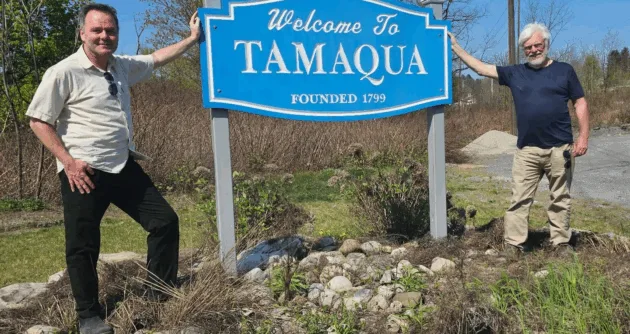
The first rights of nature law enacted anywhere was drafted and shepherded into being by CELDF in September 2006 in a little Pennsylvania borough called Tamaqua. That was the beginning. Within a few months CELDF was enlisted by the Ecuadorian Constitutional Assembly to consult with them while they framed new constitutional language recognizing the rights of Pachamama, or Mother Earth. In 2008, that language was ratified by a significant majority of citizens, and Ecuador became the first nation on Earth to recognize fundamental rights for nature.
Since then, each of the scores of municipal laws CELDF drafted and consulted with municipal, community, and tribal leaders in the U.S. to enact included rights of nature provisions. They were mostly rural communities with scant resources, with the exceptions of Pittsburgh, Pennsylvania and Toledo, Ohio.
Litigation occurred in about ten percent of municipalities that enacted CELDF community rights ordinances and rights of nature ordinances. Toledo’s Lake Erie Bill of Rights was overturned by an agribusiness corporation’s challenge that claimed, among other things, that recognizing the rights of the Lake Erie watershed violated the civil rights of a legally personified corporate entity named Drewes Farms.
Over the years, CELDF continued refining its analysis of how to challenge existing legal obstacles to protecting the biological integrity of natural communities. We concluded a few years ago that further challenges to unjust state preemption of community rights is at best an experiential education in real civics for participating communities and observers of their struggles. Litigation viscerally exposed hundreds of community members to the antisocial subterfuge built into arcane legal doctrines.
But the time has come to pull together what we’ve learned and to
apply it strategically. We have concluded and can say without hesitation that the problems are systemically rooted. That is why we need systemic solutions. The multiple crises before us will yield to nothing less.
Conceptual Evolution
Our methods are changing. In the short term, we will continue to respond to state level requests for consultation on community and nature’s rights legislation. Following the demise of Toledo’s Lake Erie Bill of Rights, a New York legislator requested that CELDF draft a Great Lakes Bill of Rights. That language was crafted in 2021 and it has been introduced into the New York General Assembly with cosponsors. As of this writing, the bill has not been debated. An amended version is scheduled for reintroduction in the 2025 legislative session.
CELDF has begun seeking champions for similar legislation to be introduced in other Great Lakes bordering states. Beyond that and the enormous organizing challenges such a campaign entails, we will strive to implement the proposals advanced in this paper.
We have identified three related core cultural paradigms at the heart of Western civilization that show demonstrable causal relationships to catastrophic environmental and social emergencies. They are:
- human separation from and superiority to the non-human world.
- the primacy of individual advantages over community needs and the invention of monopoly-based property (enclosure) laws.
- the misapplication of scientific reductionism and the logically flawed contextualization of the whole of other-than-human existence within human culture rather than contextualizing human culture within a humanly inclusive “nature.”
These paradigms are problematic due to the kinds of attitudes and behaviors emergent from them. A deeper analysis than the bare-bones one outlined below must wait for another time.
Separation and Superiority
Separation and alienation; belief in the paradigm of human exceptionalism and superiority over the other-than-human part of reality leads to the concept of the other as property and is precursor to the impunity of attaching legal privileges that are exclusive of the community to property, seen legally as a prosthesis of the idealized self.
The dualistic, binary structure of Western imagination, as de Sousa-Santos calls it, is derivative of the bifurcation of reality into self and other. “Cogito ergo sum” (I think, therefore I am). Cogito combines “I and my thoughts” in a bit of tautological word play to produce an artificial syllogism that concludes with the abstraction of the individual from the presumably unconscious and inferior matrix of existence.
The distinction creates an asymmetrical juxtaposition of self and other, followed by a sophomoric conflation of the subjective experience of thoughts with self-evident reality. But our thought-shaping labels, definitions, and categories extract utilitarian associations, not the isness of what exists. These meaning-laden abstractions are the building blocks on which humanity’s modern separate reality has been erected.
The hegemony of the modern world view demonstrates that exceptionalism comes quickly on the heels of human denaturing, not as an empirical fact, but as a thought converted into a tautological truism.
Individualism
In a paper titled “Personhood and property in Hegel’s conception of freedom” M. Blake Wilson quotes Georg Wilhelm Friedrich Hegel, the prolific philosophical descendant of the so-called enlightenment era, saying that
[t]he rationale of property is to be found not in the satisfaction of needs but in the supersession of the pure subjectivity of personality. In his property a person exists for the first time as reason. Even if my freedom is here realised first of all in an external thing, and so falsely realised, nevertheless abstract personality in its immediacy can have no other embodiment save one characterised by immediacy.”[4]
In Western culture, individualism juxtaposes ego against community. It has proven to be a maladaptive, anti-nature and anti-community trope which all combined is ultimately anti-reality with real world consequences. Individual ownership of and monopoly control over community necessities is justified legalistically but is first contemplated conceptually by conflating property with self, with the individual, with personality. We might say this integration of materialism into the very personhood of the individual amounts to substance abuse, literally. Materialistic substance abuse is accompanied by all the ancillary social ills associated with drug addiction: sociopathology, violence, theft, irresponsibility, loss of moral grounding, and exploitation of others to feed the addiction.
Reductionism
Hegel’s abstract personality in its immediacy suggests that the abstraction (vivisection really) of the individual from community through a process of conceptual (i.e. cogito) reduction is in play.
Local residents are often chided not to react out of emotion to what they discern to be environmental threats. “Trust the science,” is the mantra of polluting industries and the government agencies that legalize pollution by issuing permits. But there is a distinction to be made between pure science, limited as it is to reductionist thinking and the study of parts, and applied science, which is further tainted by the prejudices of advocates for those applications.
Nor is it ethically acceptable for any authority to quantify the tolerable number of additional illnesses or deaths projected to result from permitting ecologically suspect activities. Ethical judgements of this sort are best left to the communities affected to decide, regardless of the graphs and statistics that accompany scientific impact studies and other reports.
Alongside this top-down judgement about the quantified loss of biological integrity acceptable to the state is the extreme narrowing of the scope of harms government bothers to regulate. CELDF organizers have abundant experience with representatives of regulatory bodies pointing out to packed public hearings that, for instance, the siting and operation of a proposed gas well is legally allowed despite the statistically significant chance that residents’ water wells will become toxic. Using another example, the EPA’s long-standing approval of the land application of toxic sewage sludge for ersatz fertilizer has long been known to pose health problems for humans and animals. Since 2004 CELDF has shared information on toxins such as dioxin, heavy metals, low-grade radioactive waste, carcinogens and pharmaceuticals in the sludge. Today, “forever chemicals” have joined the mix. Yet the federal agency and its state-level counterparts have rationalized continuing to allow the practice by not requiring testing for the worst toxins known to be constituent contaminants in wastewater solids. Denial is construed as a lack of evidence for harm, and that adamant ignorance of harm is translated into a license to pollute. Trust the science.
Disenchantment, the negation of the metaphysical critique, as Jameison calls it, may be more than a reaction to official callousness. Loss of faith in the mystique of American justice could be a psychological epiphenomenon of applying reductionism to living systems. A sui generis quality of matter animated by life is its self-organizing processes in seeming contradiction of the universality of the law of entropy. Applying the reductionist study of parts to understand the unpredictable emergent qualities and behaviors of living systems in an attempt to demystify, simplify, and pigeonhole them, and then use the results of such studies as reliable predictors seems doomed to misinform all-around.
In Newtonian physics, upon which scientific reductionism relies for its logic, self-organization is understood to occur in matter only through the influence of irreducible natural forces including gravity, electromagnetism, etc.. Scientific reductionism eschews subjective agency in any of it. While examining, say, the growth of crystals, science can reduce their seeming self-assembly to the predictable interplay of relationships (forces) among elemental electrons in silicate molecules. But we encounter unpredictable emergent qualities uniquely in the context of living systems, whether single-celled organisms or complex ecosystems, that do not yield their secrets through Newtonian based reductionism.
In the biological context, reductionism is a form of vivisection. Perhaps life cannot be understood through the scientific method’s crude manipulation of matter. Subsystems of life may be explored, but very likely not more than superficial aspects of the mystery of in vitro matter in communion with other life and its own subsystems will be revealed.
Toward Biocentric Natural Communities
By shifting our focus “to actionable RoN that will protect humans and nature,” as Jameison suggests, we can conjure a counterspell to the nullification of the metaphysical critique imposed by the modern spell-like trance these paradigms have unleashed on society and the world.
CELDF is developing projects that can prepare communities to transition from active but involuntary collusion in destroying their local environments to actively and intentionally defending their natural communities against financed and permitted environmental assaults.
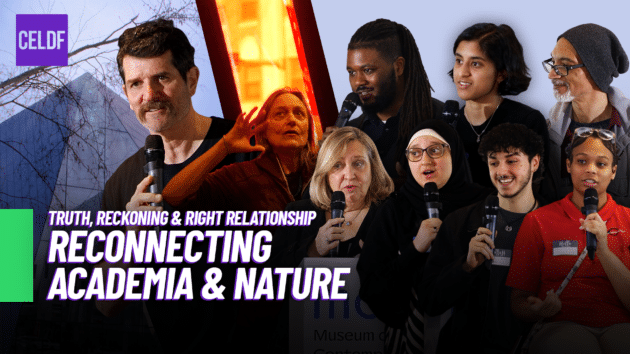
Creating safe spaces for people to acknowledge their contributions to the rapid decline of living systems on Earth can begin the process of people realigning with the other-than-human part of reality. CELDF conducted a two-part pilot Truth, Reckoning, and Right Relationship with the Great Lakes (TRRR) in 2023 and 2024. Part 1 in October 2023 focused on the hard truths of our shared complicity, and in April 2024 CELDF convened an expanded, multidisciplinary, and diverse group on two consecutive days to focus on how to reckon with the truth and develop right relationships within human and natural communities.
Both events occurred in Cleveland, Ohio. The first gathering met at the Rock and Roll Hall of Fame. During the two-day conclave in April CELDF was hosted by the Museum of Contemporary Art (moCa), where visual artist Andrea Bowers’ exhibit was devoted to the work of CELDF and both Toledo’s Lake Erie Bill of Rights and New York’s Great Lake Bill of Rights. The legal framing of the rights of nature movement, we now conclude, is incomplete without honoring the cultural dimensions of the movement.
A guidebook to assist communities across the nation to organize their own local versions of Truth, Reckoning, and Right Relationship is being developed by CELDF. At the heart of these TRRR events is an opportunity for community members to confront their own cognitive colonization.
To expose for self-interrogation the attitudes and behaviors that make us unwittingly complicit in eco-predation is to create the possibility of deviating from modern society’s eschatological trajectory. Personal epiphanies were the norm in our pilot events. We think some version of TRRR gatherings may be valuable, if not indispensable, to provide a venue for other personal epiphanies and more importantly the ground for the formulation and collective movement for initiating local ecological self-determination by communities in every bioregion.
FINDINGS
When Thomas Jefferson listed the colonist’s grievances against the crown as he wrote the Declaration of Independence, he borrowed from resolutions sent to the Continental Congress by more than ninety towns and counties – local governments – throughout the colonies.[5] Among the more than thirty complaints he listed, the very first one mentioned in Jefferson’s Declaration is the preemption of local laws by the central government in London: “HE [the king] has refused his Assent to Laws, the most wholesome and necessary for the public Good…”
The revolutionaries were not talking about being prevented from making state or federal laws. There were no states and there was no nation. It was the usurpation of the people’s right to enact and enforce laws in their own communities that had them up in arms.
Today, across the country, this is the same complaint CELDF organizers have heard in town after town. States and the federal government routinely preempt local laws intended to protect workers, immigrants, the homeless, and to fend off resource stripping, toxin dumping and property confiscation. The most frequent exercise of state preemption of municipal laws throughout the states is against local laws enacted to protect local ecosystems.
What American revolutionaries listed as their first order of business to correct through revolution is now the chief counter-revolutionary project enforced through ceiling regulations and state preemption of environmentally protective local laws.
Experimenting with biocentric communities in the U.S.
The United States of America is the place where the first rights of nature laws were enacted by any modern government, but it will likely be one of the last countries on Earth to recognize those rights nationally. If this seems pessimistic, there may be some cheer in knowing that there have been more RoN laws enacted in the U.S. than anywhere else as well. CELDF is responsible for writing and organizing communities for adoption of the lion’s share of those laws.
But where RoN laws have been challenged, the judiciary at state and federal courts has uniformly overturned and voided municipal, county, and home rule laws elevating local ecosystems to the status of rights-bearing members of those communities. Our very brief critique of the premises of Western cultural paradigms was no mere academic exercise. Understanding them can help us to process and articulate the flaws in the obdurate opposition of the courts to laws that treat ecosystems as entities having agency similar to those humans granted legal standing before the courts. In fact, the reasons given, when they deigned to give them, for rejecting the few RoN laws that have been presented to the bench, aside from procedural trap doors, have rested on the temerity of RoN proponents and their attorneys in challenging those premises.
The United States may be an empire spanning a large part of the continent that Native Americans call Turtle Island, but even against the tide of imperial expansion and geopolitical chaos, we can build toward place-based ecological balance by appealing to remnant beliefs in community self-determination already dwelling in the hearts of the people, and by building on those existing and still-remembered principles of the American Revolution, and the government it intended to birth.
Despite a two and a half century hiatus from realizing those revolutionary goals, Americans have a place to begin, with ideals that are loudly honored with nationalist fervor, although systemically thwarted.
Natural justice is based on respect and reciprocity. Today, systemic opposition to natural justice stands between us and survival, between so-called nature and humanity. As we have cataloged elsewhere,[6]the history of law’s development in the United States has deep roots in English common law, with many class-based tropes and general deference to wealth-bound privilege. Although U.S. law discounts revolutionary documents like the Declaration of Independence and Thomas Paine’s Common Sense as legally non-precedent-setting, still we have a place to begin. American Revolutionary theory shaped the constitutional scaffold of Federalism, which:
- Is already place-based (geographical boundaries and jurisdictions include states, counties, and municipalities)
- Concedes that sovereignty theoretically resides in “the people.”
- Concedes in most state constitutions that all citizens enjoy a right of self-determination and local self-governance.
- Formally recognizes rights of the members of the community, although through judicial dicta known as Dillon’s Rule and industry biased state preemptions based on that court dicta, collective community rights to protect the local environment are now routinely denied.
- The Cooley Doctrine, which recognized the unalienable right of Americans to local self-government was expressed by Michigan State Supreme Court Justice Thomas Cooley, a contemporary of John Forrest Dillon and a constitutional scholar. The Cooley Doctrine might have prevailed over Dillon’s Rule and could still replace it without upending federalism.
Modern American courts, long since captured by corporate monetizing of democratic elections and politicization of high court appointments, found undemocratic work-arounds to nominalize these ideals while negating them in practice. America’s national founding story has kept these defining principles of American governance alive, despite their having been mothballed by constitutional design and their remnant effects curtailed further by court dicta.
Take the example of Dillon’s Rule. It originated in an Iowa state court and is based on Judge John Forrest Dillon’s 1868 interpretation of a theretofore obscure finding in the celebrated 1819 Dartmouth College case[7]which famously transformed the privilege of commercial incorporation through state charters into a contractual agreement between the issuing state and the incorporators. Dillon found that the Court also invented a distinction between private business corporations and suddenly public municipal corporations. And although no court has declared the right of self-government to be void at the local level, since the Supreme Court nationalized Dillon’s Rule in the opening days of the twentieth century,[8]declaring absolute state supremacy over local law making, the ability of municipal governments to protect local environments when states issue permits for environmentally destructive corporate projects has been routinely preempted (forbidden).
The courts have ruled ever since that state preemption is not an abrogation of the right of the people to self-govern. That right still exists in theory and is expressed in most state constitutions. But the right of communities to use the state’s municipal corporations for that purpose is denied “in toto,” as John Forest Dillon put it in his 1872 Treatise on Municipal Corporations.[9]
The suspect logic of this systemic denial of democratic rights is equivalent to the Court declaring that although every American retains the right to ride a horse, it is illegal for any horse to bear a rider. Replacing Dillon’s Rule with a version of its pro-democracy alternative, the Cooley Doctrine, may be the simplest way to facilitate devolution of ecological governance to municipal, county, and tribal governments.
To be clear, the Cooley Doctrine is not a perfect fit, but does champion the right of community self-government. We suggest it in this context because it was proposed contemporaneously with Dillon’s doctrine. As such, the judiciary could have embraced its democratizing power rather than Dillon’s domestic imperialism. Even if the Cooley Doctrine’s exemplary elements were adopted, the whole facade of government built upon human exceptionalism would continue chipping away at what had been gained, as CELDF has learned, for instance, in the context of the lack of enforcement of Pennsylvania’s fifty-five-year-old “green” environmental amendment, Article I, Section 27 of the Commonwealth’s constitution. Despite the Declaration of Rights being self-executing, as stated explicitly in Article I, Section 25, commonwealth courts have routinely stumbled over finding anything in it to enforce.
Revitalizing decommissioned revolutionary ideals by overturning the routine procedural denial of basic rights can be achieved by devolving ecological self-determination to all place-based natural communities. Doing so will simultaneously reverse Western civilization’s absurd separation of humans from their natural environment and conjoin community rights with the rights of nature.
Using de Sousa-Santos’ word, we must demonumentalize legal precedent that oppresses, stands in opposition to and disregard of community. In the necessary project of correcting our relationship with “nature,” we can eliminate the need for top-down control of natural communities by admitting the anti-social and anti-life effects, if not intent, of those precedents and by localizing authority over environmental protection.
The justification for instituting such local authority over all things impacting local environments is the factual non-separation of human residents from those local environments and the natural role those residents play as the human voice of the natural community in which they are immersed as biological community members.
CONCLUSION
- What happened to the public’s trust and the once sufficiently credible belief that American law would stand with the people and protect the environments in which they live and on which their lives and health depend?
It was once sufficiently credible to believe the idealized promise of the Public Trust Doctrine until the courts began dismissing claims of violated community rights with predictable and increasing regularity, dismissing rights-based ordinances with state laws preempting local land use regulation. In simpler terms, claims of rights violations were dismissed as preempted by laws protecting the rights of corporations to engage in state-permitted environmental harm.
Some headway was made in the Commonwealth of Pennsylvania when in December 2013 the Pennsylvania Supreme Court overturned Act 13’s stripping of local land use authority to regulate surface siting of natural gas extraction, relying on Article I, Section 27, the 1971 “Environmental Rights Amendment” of the state constitution. The court declared that a state statute could not strip the constitutional right “to clean air, pure water, and to the preservation of the natural, scenic, historic and esthetic values of the environment,”[10] nor interfere with the obligation of local governments to secure those rights since “the constitutional obligation binds all government, state or local, concurrently.”[11]
As encouraging as this may appear, a decade later, Pennsylvania’s courts have not further deferred to local legislation, and neither have the federal courts. When CELDF attorneys were sanctioned for raising the question of fundamental rights again and again in litigation, the judge insisted community complaints could be dismissed on grounds of state preemption of local land use laws. The adamant stance against community rights assumed by the state became crystal clear.
- Despite judicial hostility, why have so many municipalities enacted local community rights and rights of nature laws in the U.S.?
Social anthropologist Mary Douglas observed years ago that “As consent withdraws from the system of control, leaders lose their credibility, and so does their magic.”[12] The story of people’s withdrawal of trust is the story CELDF community organizers can tell. They have been telling it from front-line experience for three decades.
The main themes of that story are community betrayal, confrontation, and defeat at the hands of laws that have proven to be overwhelmingly deferential to what are called “commercial interests,” but are in fact the same privileged interests as ever. Like the aristocrats who compelled King John to sign the Magna Carta, a 1215 peace treaty that outlined power-sharing between the wealthy and the sovereign, modern law serves the same alliance of wealth and power. It was the Charter of the Forest of 1217 that defined the meager rights of commoners to forage the common lands from which they’d been dispossessed by the Crown’s enclosure movement.
Periodically in history people have come together in community and mounted powerful acts of resistance against official cancellation of place-based community and biological integrity. Today, with hundreds of municipalities willing to enact rights of community and nature laws, the rumblings of a widespread people’s movement can be felt. The groundswell is palpable. Typically. conservative and conformist communities are exploring extrajudicial avenues in search of their lost kinship with neighbors and with nature.
- How was this same hierarchical structure transplanted into American jurisprudence, which touts equality under the law?
The answer was not obvious to community members who for thirty years have sought CELDF’s help to navigate around the anti-democratic trap doors built into present law for quick procedural dismissals of community grievances.
The community members we engaged came to realize that their states issue permits to corporations that the state charters and licenses, and that the courts insist those corporations are not state actors despite being created and enabled by the state. By court precedent, corporations, as “private actors” are incapable of violating legal rights.[13]State permits legalize corporations’ destruction of community environments.
The circularity of official logic used to rationalize legalized assaults on natural communities becomes hard to ignore with experience. In 2010 the Independent Petroleum Association of New Mexico recognized the potential of a movement for community rights and rights of nature when it declared them to be “the beginning of a social movement that is greater than just the oil and gas industry, it is a potential game changer for all of corporate America.”[14]
Now hundreds of counties and municipalities have legislated locally to establish and assert community rights and approximately forty local communities in the U.S. have legislated the rights of local ecosystems into law. Some have litigated challenges to their sane, responsible, biocentric municipal ordinances and home rule charters, with CELDF’s assistance. In the process, residents have encountered systemic antipathy for community rights when pitted against corporate privilege.
Dillon’s Rule, the legal theory that municipalities are state-erected public corporations under complete state control, adds insult to injury by classifying the people living within municipal jurisdictions as mere tenants with no local self-governing authority. The neutralizing power of preemption, based as it is on Dillon’s Rule, places strict limits on how protective of local ecosystems community ordinances are permitted to be.
CELDF organizers know from countless campaigns that the American people never encounter the full force of anti-community, anti-social, anti-“nature” state and federal law except when they get caught-up in the judicial system and experience uniformly unsuccessful results. They dare to act on the premise that communities enjoy a fundamental right of self-defense against toxic trespass and noxious exploitation, only to be overturned by privilege-over-rights court verdicts.
It is well-past-time that the obstacles routinely erected against so-called “NIMBY” communities be cast aside. “Not In My Backyard” is a churlish accusation of selfishness that industry public relations professionals dust off again and again when communities attempt to safeguard their natural habitat’s health and livability.
Formalizing a Trust the Public Doctrine that gives plenary power over decisions affecting local ecosystems to municipalities, counties, and tribes may be a trifecta solution to 1) global ecological collapse and rampant corporate ecocide, 2) the false claim that humans are separate from and superior to “nature,” and 3) the notion that individual rights attached to privatized and monopolized property supersede the collective rights of natural communities.
It is time to make direct local environmental democracy the law of the land. Necessity demands this democratization and liberation of natural communities from precedent fortified imprudent and impudent law. And let us again be clear on this point: for our strategy to be pragmatic it need not be welcomed by the current systems of law, governance, and material power. Pragmatism driven by existential necessity is sufficiently pragmatic with or without official permission.
Every excuse standing in the way of devolving plenary powers to communities for protection of local ecosystems has at its foundation the preservation of existing power structures. Misinformed and unresponsive public officials justify dismissing calls for systemic responses to existential exigencies as overly radical solutions because liberating natural communitieswould stifle economic growth, as if economies can grow indefinitely.
Those who say they oppose collective community rights usually speak from behind the corporate shield, which is the legal expression of collective rights for the exclusive benefit of investors seeking to amass unearned income. Short is the time we can waste answering such sophistry. The misapplication of reductionism to atomize natural communities for ease of economic husbandry must end. Since state and federal governments won’t do it, communities must take on the challenge themselves, community by community, building a movement on a commitment to protecting future generations.
CELDF and its partners seek other partners with knowledge of aspects of that dynamic movement away from materialistic addiction and back into biocentric relationship with our extended family in the natural communities we call home. And so, we share with you this visioning as a meditation on alternatives to centrally controlled and suspect plans for the further vivisection of natural communities in the process of amputating their inherent rights.
[1] 5 Young, Myles Douglas, “The Public Trust Doctrine: A Cracked Foundation,” The Georgetown Environmental Law Review, April 15, 2021
[2] More Than Human Rights: An Ecology of Law, Thought, and Narrative for Earthly Flourishing, César Rodríguez-Garavito, ed. (New York: NYU Law, 2024).
[3] Santos, Boaventura de Sousa, The End of the Cognitive Empire: The Coming of Age of Epistempologies of the South, Duke University Press, (2018)
[4] M. Blake Wilson, California State University, Stanislaus Personhood and property in Hegel’s conception of freedom, https://philarchive.org/archive/WILPAP-29
[5] Pauline Maier, American Scripture: Making the Declaration of Independence, 1997
[6] Price, Ben G., How Wealth Rules the World: Saving Our Communities and Freedoms from the Dictatorship of Property, Berrett-Koehler Publishers (2019)
[7] Trustees of Dartmouth College v. Woodward, 17 U.S. (4 Wheat.) 518 (1819)
[8] Hunter v. Pittsburgh, 207 U.S. 161 (1907)
[9] Dillon, John F. LL.D, Treatise on the Law of Municipal Corporations, James Cockroft & Company, Chicago, (1872)
[10] Article, I, Section 27, Pennsylvania Constitution
[11] Robinson Twp. v. Pa. Pub. Util. Comm’n, 83 A.3d 901, 952 (Pa. 2013) (citing Pa. Const. Section 27, Court stated that protection and enhancement of citizens’ quality of life “is a constitutional charge which must be respected by all levels of government in the Commonwealth”); see also Hartford Accident & Indem. Co. v. Ins. Comm’r, 505 Pa. 571, 482 A.2d 542, 549 (1984) (Declaration of Rights provision “circumscribes the conduct of state and local government entities and officials of all levels in their formulation, interpretation and enforcement of statutes, regulations, ordinances and other legislation as well as decisional law.”).
[12] Mary Douglas, “Natural Symbols: Explorations in Cosmology, “ (Routledge; 3rd edition, 2015)
[13] The Civil Rights cases of 1893 (Civil Rights Cases, 109 U.S. 3, 11 (1883). 3), ruling declared that constitutional rights protect citizens against infraction by the state but not by private actors.
[14] Energy-New-Mexico-2014.pdf (ipanm.org)