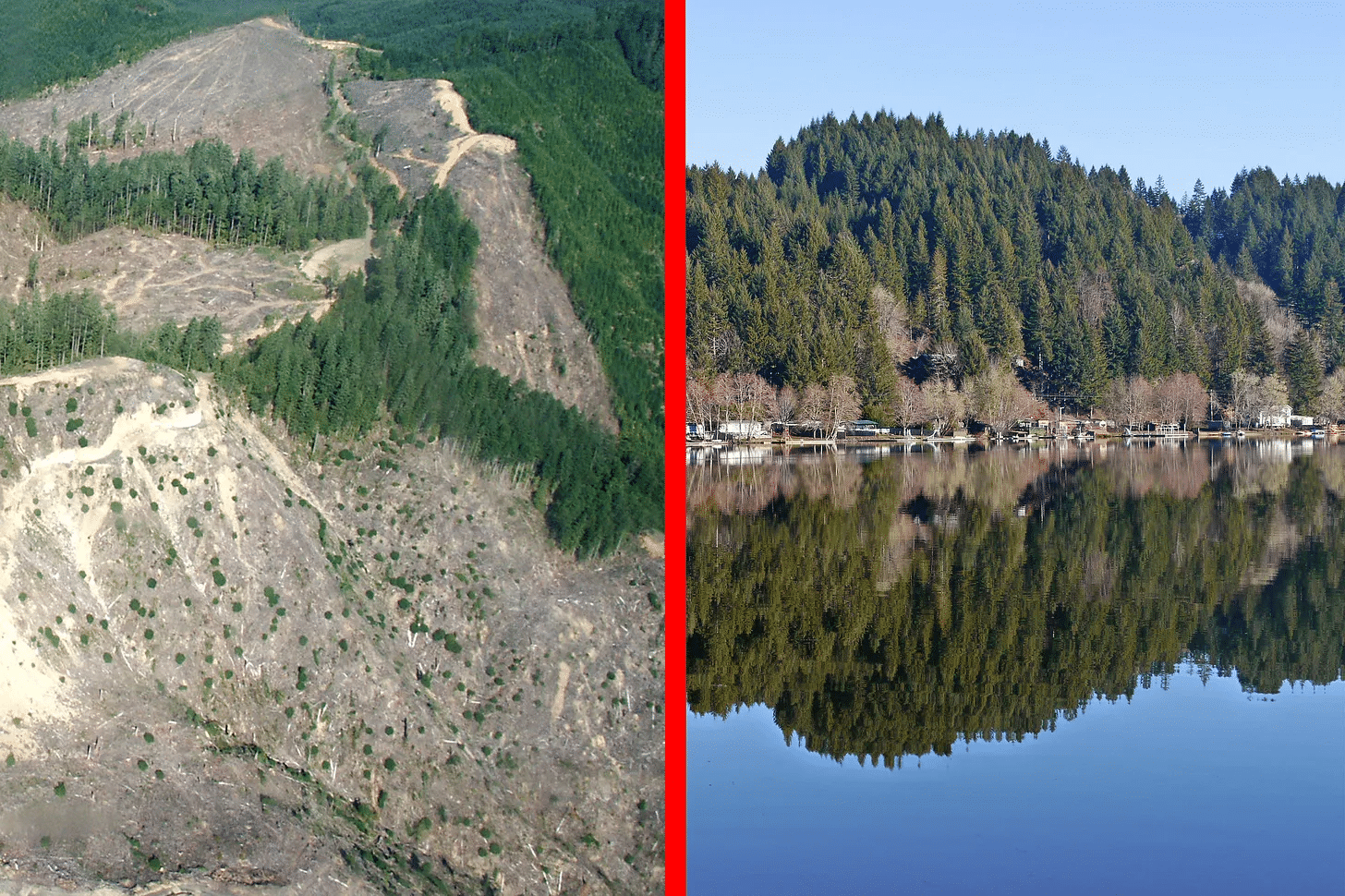
Left: clearcut plantation forest on Weyerhauser land in western Oregon. Photograph by Francis Eatherington, Right: Triangle Lake in Lane County, OR. Photograph by Rick Obst. Both are licensed under CC BY-NC 2.0.
Contacts:
Michelle Holman
541-525-9901
mholman@peak.org
www.
Tish O’Dell
CELDF Consulting Director
Tish@CELDF.org
440-552-6774
“Water is Life” — Lane County, Oregon Seeks Watershed Rights
Citizen vote in May is as much a referendum on corporate power as it is about protecting watersheds
Lane County, OR – Should people have a right to clean drinking water and healthy rivers and streams? Or, should corporations have the legal right to pollute and harm water?
That question is going to voters in Lane County in western Oregon this spring.
Measure 20-373, “the Lane County Watersheds Bill of Rights,” will be on the ballot for the May 19th election. More than 14,000 county residents signed a petition to qualify for a popular vote.
The law, which is part of a broader global push for legal “rights of nature,” would have three main effects. First, it would recognize and protect the rights of rivers, streams, wetlands, and aquifers to exist, flourish, and naturally regenerate along with people’s right to access healthy drinking water. Second, it would provide for more direct means for people and the government to legally defend these rights. And third, it would expand local democracy related to the watersheds by allowing the county and city governments to set additional greater protections than currently exist in state or federal law.
“A ‘yes’ vote on Measure 20-373 is a vote for clean water, recovering salmon runs, mature forests, and a sustainable, healthy community” says Rob Dickerson, one of the organizers behind the measure. “Business as usual is not ‘normal.’ It’s a slow motion disaster. We’ve all been affected by fires, extreme heat, and environmental toxins which cause diseases like cancer. We have a chance to change that path for Lane County.”
Driven by global warming, Lane County is expecting declines in flow of more than 50% in most rivers and streams as well as soaring water temperatures by the 2040s.
These changes will threaten remaining salmon populations, many of which are endangered, as well as steelhead and other wildlife, forests, and water supplies for agriculture and drinking.
It will also threaten outdoor recreation, an industry which supports 192,000 jobs and $20.6 billion in total economic output across the state, and drive up costs for households.
Already, it’s estimated that extreme heat is costing the average Lane County household nearly $9,000 per year in lower wages, decreased productivity, and increased costs.
Oregon’s largest contributor to warming is the timber industry, which is responsible for 35% of the state’s carbon emissions. Clearcut landscapes create a “flood and drought” cycle which causes erosion and further decreases water quality and quantity, and private forestlands across the state are regularly treated by aerial spray of pesticides which have been linked to cancer, reproductive health issues, and other serious illness.
“We’re sick and tired of a system in which a few wealthy corporations have the legal right to pollute our water, poison our communities, and destroy the climate,” says chief petitioner Michelle Holman, a resident of Lane County. “We’re pushing back.”
Under current law, nature has no inherent rights, and is considered “property” to be managed, owned, and exploited. The rights of nature movement argues for expanding our recognition of rights to nature, just like the United States expanded rights to black former slaves, and then to women, in the 19th and 20th century. These rights include both the inherent rights of watersheds themselves, as well human rights to live in healthy watersheds as one of the species connected to and part of the watershed.
Critics of the measure, including representatives of timber corporations who are rallying opposition for a “no” vote, say that the measure is illegal and unenforceable, and will lead to lawsuits. What they’re not saying is that the lawsuits would be coming from the corporations unwilling to adhere to real environmental and human health protections.
“We are in a movement moment, and movements exist to challenge unjust laws like those governing corporate timber practices today in Oregon.” says Kai Huschke, the executive director of the Community Environmental Legal Defense Fund, which has helped spread the rights of nature movement across the United States and is assisting Lane County residents with this measure. “Local, State, and Federal government has failed Lane County when it comes to real environmental and community protection for their watersheds. Voting yes on this measure is a step towards correcting for that failure.”
Attorney Terry Lodge, Legal Director at CELDF, agrees. “Regulatory laws have failed to protect Lane County watersheds because they treat watersheds as property to be polluted and used by watershed owners,” Lodge says. “Regulatory laws do not prohibit harm to Lane County watersheds; regulatory laws simply determine the rates of degradation and destruction of Lane County watersheds. This effort is a grassroots rebellion against this system of managed decline. It’s something categorically different: an attempt to make law rooted in the fundamental truth that water is life.”
###
About the Lane County Watershed Bill of Rights
Protect Lane County Watersheds (Yes on Measure 20-373) is the PAC moving forward The Lane County Watershed Bill of Rights — Measure 20-373 — to secure Right of Waters and Watersheds to sustainable recharge and to protect our drinking water.
About CELDF — Community Environmental Legal Defense Fund
CELDF is a nationwide community of organizers, lawyers, and partners who educate, agitate, and organize to confront systemic injustice and restore humanity’s reciprocal relationship with Earth. For over 30 years, we’ve helped communities resist corporate exploitation, reject regulatory false promises, and assert their right to self-govern through systems grounded in ecological balance and collective power.
Today, CELDF continues to promote and collaboratively define Rights of Nature principles through proposed legislation like the Great Lakes Bill of Rights, introduced into the New York State Assembly by Member Patrick Burke, and a number of pending local bills, its Truth, Reckoning, and Right-Relationship program, and now expanding its efforts into community resistance and resilience efforts. More information about CELDF, including photos pre-approved for media use, can be found in our press kit.